Visit Graves of Historic Figures in St. Landry Parish
Cemeteries are more than a final resting place. They are echoes of the past that allow those who have passed on to live anew in stories told and retold across generations. In rural Louisiana, the small-town cemeteries of St. Landry Parish house those who have lived lives of acclaim and tragedy. With gold medal Olympians, Grammy-winning musicians, and even Napoleonic-era military tacticians, St. Landry Parish has long been a cradle for the talented and the extra-ordinary. Their graves become a reminder of their great feats.
Rodney Milburn
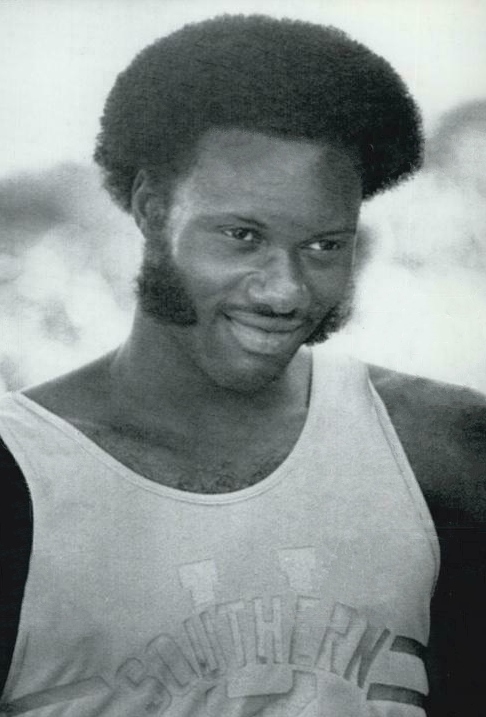
1971 Rod Milburn Southern University Breaks AAU Hurdles Record
Located off scenic Highway 743 which follows along the Bayou Courtableau just outside of the Zydeco Capital of the World is a small collection of graves shaded by pecan and oak trees with no church to be seen. Here lies Rodney Milburn, the Olympic gold medalist who lived a life of great achievement and great misfortune. Rodney went from homemade hurdles at the segregated J.S. Clark High School all the way to the worldwide Olympic stage at Munich in 1972 to win gold with his innovative hurdling technique.
Milburn was among the first black sportsmen to be recognized by the Louisiana Sports Writer’s Association, broke the 12-year standing world record for the 120-yard high hurdles by 13 seconds at the National AAU meet, and went undefeated for 28-straight races. These feats preceded his success at the Olympics. Due to technicalities, he couldn’t compete in 1976 and the U.S. boycotted the 1980 games in Moscow. Though his Olympic stint was short, it was no less impactful for the people back home in Opelousas.
During those times, Olympic fame didn’t automatically mean financial success. Milburn spent the last few years of his life in poverty. His death in 1992 was a shock to friends and family.
Hundreds came out to his funeral and even after death athletes looking to pay respects occasionally make the pilgrimage to his grave located at Green Chapel Cemetery at 2858 Hwy 743, Opelousas, LA 70570.
Dennis McGee
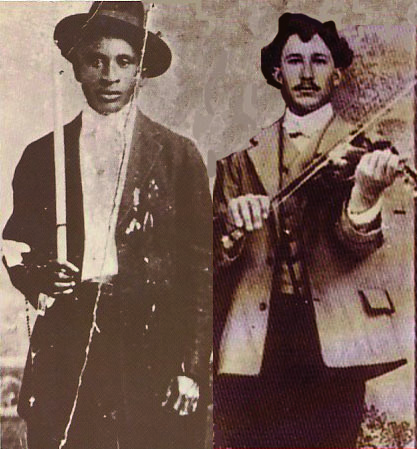
Amédé Ardoin and Dennis McGee
Dennis McGee, alongside Creole vocalist and accordion master Amédé Ardoin, made up a multi-racial musical duo that performed for house dances and at dance halls throughout rural Louisiana. Together, on December 9, 1929, they recorded six songs which were among the first recordings of the Cajun, Creole regional style of music. After Ardoin’s tragic, racially motivated death in 1942, McGee went on to champion Cajun music and create a legacy of fiddle players under his tutelage. This influence continues today with modern players still drawing inspiration from his distinct style.
The “McGee style” of fiddle playing harkens back to a time when Cajun music didn’t have the accordion to accompany it. While the exact timeframe for when accordions became ubiquitous with Cajun music is unknown, McGee’s style is decidedly Acadian with all the medieval influence that entails. His impact extends beyond Cajun music. His son, Gerry McGee became a world-famous guitarist with The Ventures.
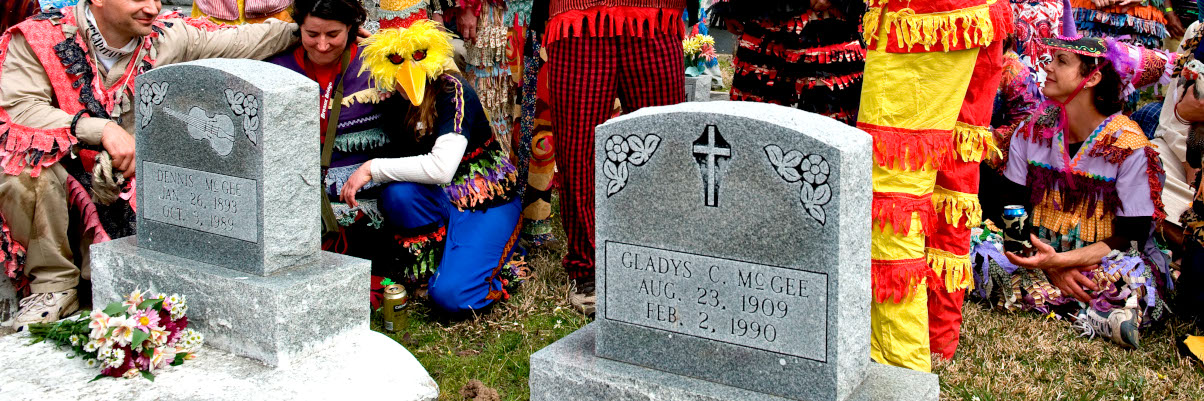
Born in 1893, McGee continued playing festivals and concerts well into the 1980s when he was in his 90s. He passed away in 1989 in Eunice, the place he was born. His grave remains a popular spot to visit for music enthusiasts and fans. The Faquetaigue (feh-kuh-tie-ay) even makes it a stop on their courir de mardi gras. You can find his grave at 7079 Chataignier Rd, Ville Platte, LA 70586.
Rockin’ Sidney Simien
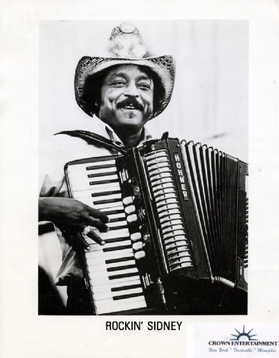
Sidney Simien, better known as Rockin’ Sidney, is a zydeco musician from the northern part of St. Landry Parish in a little town called Lebeau. Born in 1938, Rockin’ Sidney grew up with a talent for the harmonica and guitar. In the 1960s, he was primarily a blues and soul performer, but by the late 1970s he switched to playing the accordion.
His impact on the zydeco scene can’t be understated. His single “Don’t Mess with My Toot Toot”, released in 1982, is known as the zydeco genre’s first international hit. The song made it onto the Top 20 of the Billboard Hot Country Songs chart and sold over a million copies, as well as a host of other awards. In 1985, Rockin’ Sidney earned a Grammy for the song in the Best Ethnic or Traditional Folk Recording category.
“Toot Toot” would be his only international hit, but he continued to perform and make zydeco classics within the scene.
Rockin’ Sidney died in 1998 at the age of 59 from throat cancer. He is buried at the Immaculate Conception Church in Lebeau located at 103 Lebeau Church Road in a grave featured prominently near the church. The Lebeau Zydeco Festival takes place on the church grounds and is an excellent time to pay the zydeco legend a visit.
Beau Jocque
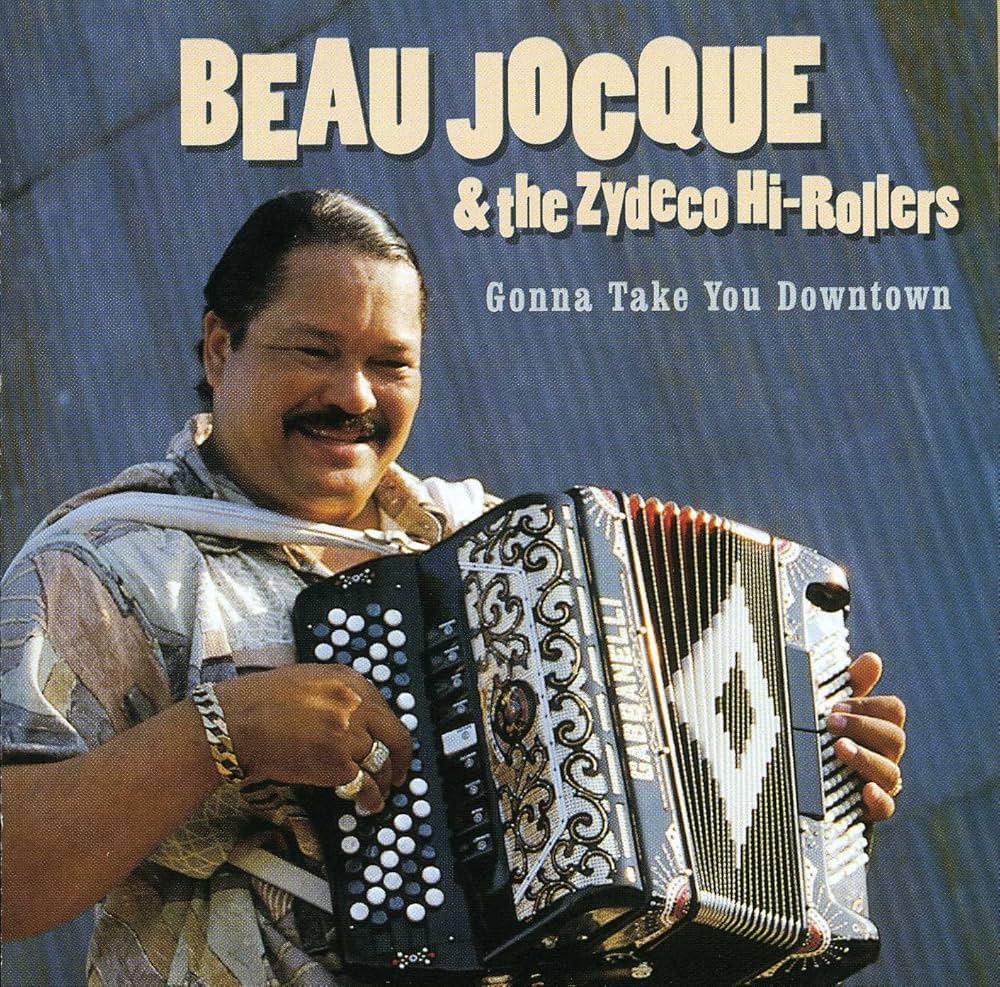
Beau Jocque, born Andrus Espre, was one of the top dancehall acts in the 1990s. His name translates from Creole to mean “Big Guy”. True to the nickname, he was a huge man standing at 6ft. 6in. (some claims put him even taller at 6 ft. 8in.) and 270 lbs.
Beau Jocque ran through a gauntlet of jobs before starting his music career. After an injury during his service in the Air Force, he worked as an electrician and welder before his stint at an oil refinery which left him temporarily paralyzed after a workplace accident in 1987. During his recovery, he picked up his father’s accordion and the rest is history.
His style fused together elements of rap and rock to create a fresh energetic sound. In an interview he cites C.J Chenier, Buckwheat Zydeco, Boozo Chavis, and John Delafose as inspiration for his stage presence. Beau Jocque, backed by the Zydeco Hi-Rollers, toured the U.S. regularly and released six albums nationally and more on his own label.
Beau Jocque and Boozoo Chavis had a famous public rivalry even going as far as to perform showdowns to sold-out crowds. The rivalry was all for show, however, as the two were friends behind the scenes.
In 1994, Beau Jocque died at the age of 45 to a heart attack. He is interred at Saint Matilda Cemetery in Eunice located at 640 North Martin Luther King Jr. Road.
Antoine Garrigues de Flaugac
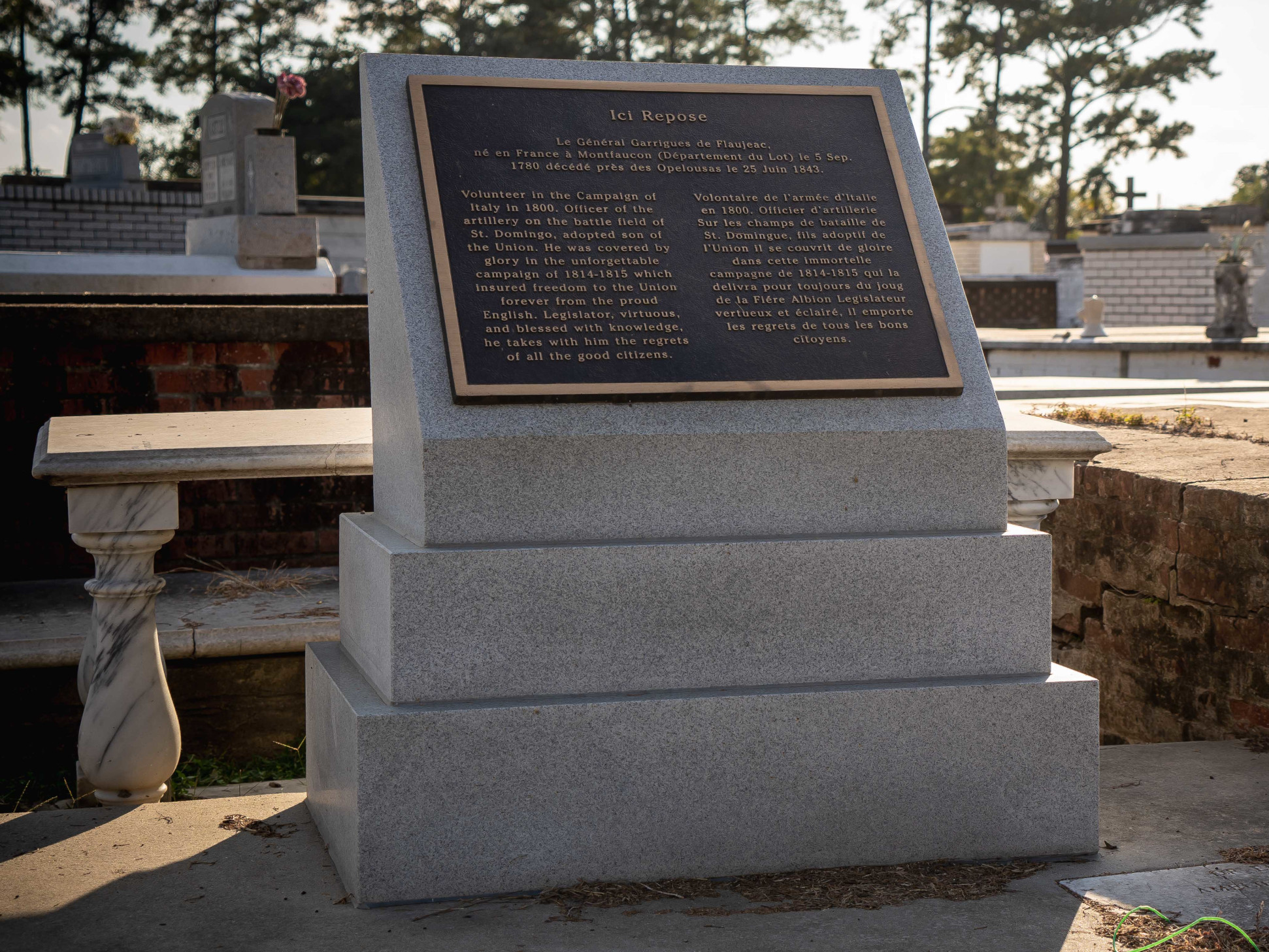
At the St. Landry Parish Catholic Church’s Cemetery, a rare table tomb marks the grave of Antoine Garrigues de Flaugac. Flaugac was a young general in Napoleon’s French Revolutionary Army and served during the Italian Campaign in 1800. He traveled to San Domingue, now Haiti, in 1803 and attempted to help quell the slave uprisings there. His efforts were unsuccessful. According to letters he wrote to his mother in France, Flaugac was captured by the English, imprisoned in Cuba, released in 1804 after the colony had gained independence, then shipwrecked a year later when he tried to make his way back to France. At 25, Flaugac was adrift in more ways than one.
When he was rescued and brought to New Orleans, a chance encounter with a prominent citizen from St. Landry Parish turned his feet to Opelousas. He married, settled down, joined the Louisiana State Militia, and was one of Louisiana’s first state senators. He even fought in the Battle of New Orleans, a decisive victory against the British during the War of 1812.
Flaugac died in 1845 as a respected citizen. His grave, located at 1020 North Main Street in Opelousas, is a common stop during the St. Landry Catholic Church’s Cemetery Tours and Reenactments which happen annually on the 2nd and 3rd weekends of October.
Hillary Soileau
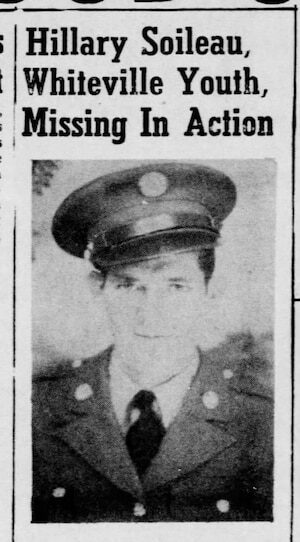 Hillary Soileau was a United States Army Private that went missing during a mission to clear Guadalcanal of Japanese forces during WWII. He was declared Killed In Action in 1945.
In 2019, Soileau’s younger sister, the 85-year-old Mary Soileau Badeaux who would have been nine or ten when he was deployed, was contacted by the Defense POW/MIA Accounting Agency to provide a DNA sample. The agency’s goal was to investigate the identity of remains, designated as “Unknown X-52”, that were uncovered in Guadalcanal all the way back in 1943. In 2020, they found her DNA to be a match. “Unknown X-52” was her brother, Hillary Soileau.
Funeral services were organized and by 2022 his remains finally returned home. His grave now rests alongside his parents, Odey and Leona Soileau at Cedar Hill Cemetery located at 700 West Vine Street in Washington, LA 70589. The cemetery was founded after the Yellow Fever epidemic of the 1850s when additional space was needed for burials.